
Address search for owner: the assessor roll and the recorder index
An owner search runs through two county records: the assessor's roll gives you a parcel, a name and a mailing address, the recorder's index gives you the deed. Knowing which one you hold decides what the answer means.
Updated November 13, 2026
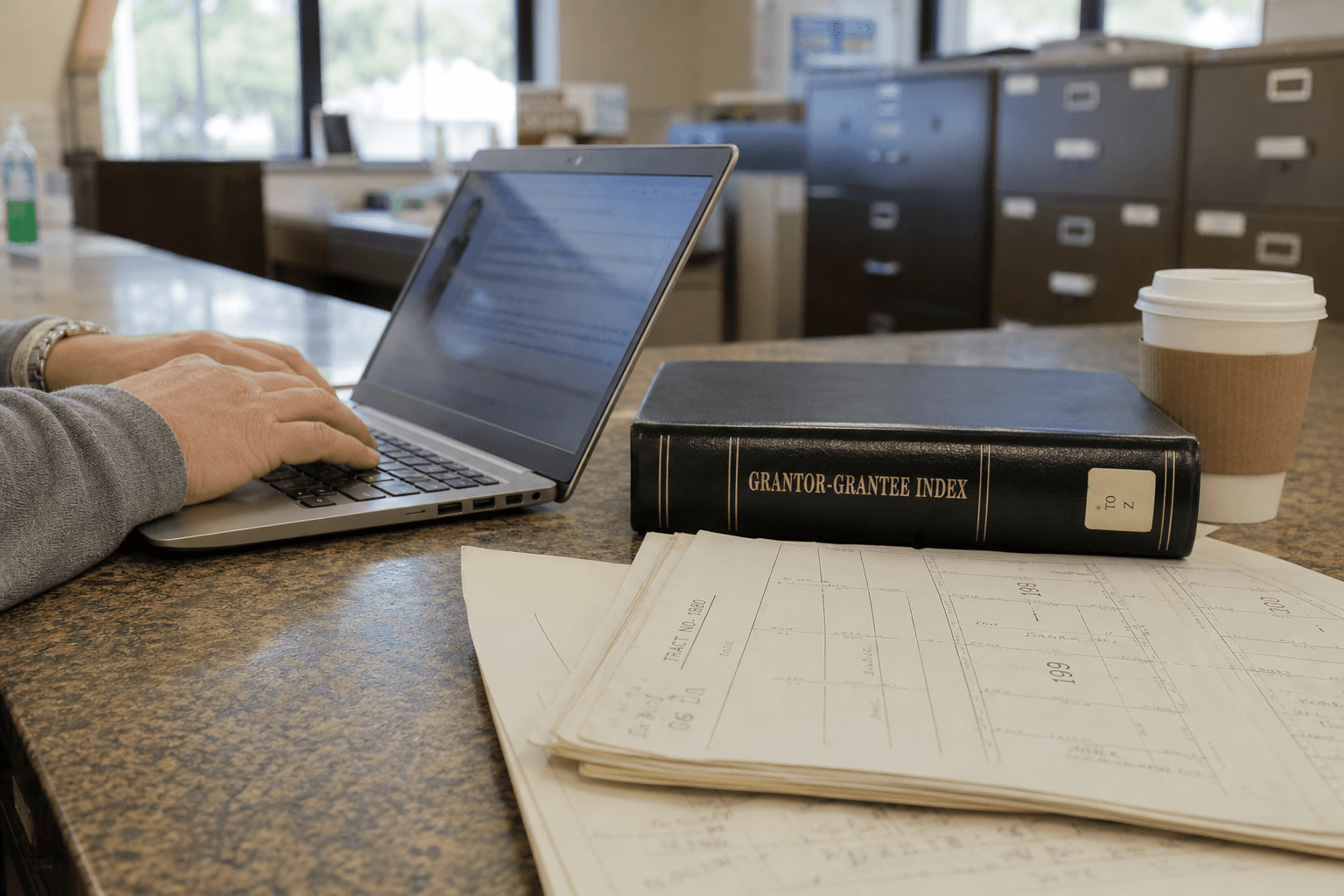
An address search for owner is two records in two county offices, not one. The assessor's roll turns a street address into a parcel, and the parcel into the name the county bills plus the mailing address on file. The recorder's grantor-grantee index holds the deed that put that name there, with the date it was recorded. Which record you are holding decides what the answer means.
The distinction matters because the two disagree regularly. A deed recorded in March may not show on a tax roll that has not refreshed, and a name withheld from a county website is still a name in the file.
What an address search for owner actually returns
The search returns a parcel number, an owner name as the county prints it, a mailing address, and, on the recorder side, a document with a recording date. People who do this work describe it as anything from a two-minute reverse lookup to a weeks-long paper trail through county records, and they start at the county property appraiser's site when title sits in an individual's name (Tracking down property owners from quick reverse lookups). That order is right. The assessor gives you a name to work with; the recorder lets you confirm it.
The assessor record is a working file
The roll exists so the county can bill property tax. Because it is a working file, it updates, it carries mailing addresses, and it flags parcels that have been split, combined or deactivated.
The recorder record is a permanent one
Deeds, liens and releases land in recording order and stay. That is where you go when the name on the roll looks stale, or when you need to know exactly when title changed hands.
The search intent behind most of these lookups is a decision made before outreach: whether to call, who to call, and whether the property is worth a call at all.
Step 1: from address to parcel at the county assessor
Los Angeles County's portal offers Basic Search, Legal Search and Map Search, and the basic field accepts either an assessor's identification number or a street address (Assessor Portal). Maricopa County searches by APN, owner name, address, subdivision, MCR number, city, ZIP code or section-township-range (How Do I Search).
Format kills more searches than missing records do. Maricopa's documented format is the number, street direction, street name and abbreviated street type, then city, state and ZIP; the city, state and ZIP can be left off. If the search fails anyway, Maricopa says to leave off the street type and search by number, direction and street name (How Do I Search). Try that before concluding the parcel is not in the index.
Los Angeles publishes its own reasons an address search comes back empty. Parcels created by deeds, new subdivisions or condominiums may not appear immediately because of parcel-change timing, and deactivated parcels are generally not displayed. A multi-unit complex, commercial property, corner lot or new development may sit under a different address in the portal, so Map Search is the fallback (Assessor Portal FAQ).
One scheduling detail catches people out. LA's property characteristics and assessment information update weekly except between the Assessor's Roll Release in July and the Auditor's Tax Extension in late September (Assessor Portal FAQ). A name pulled in August can be a year old.
Step 2: the recorder, when the assessor record is not enough
Orange County's Clerk-Recorder runs an online grantor-grantee index for property documents recorded since 1982. You search by name, and clicking a name lists every document tied to that person by document type and recording date. Recorded documents can be viewed free online or copied for $1.00 per page at the clerk-recorder's three locations (RecorderWorks Grantor/Grantee Search).
Note the direction of travel. The index searches by name, so it is a second step, not a replacement for the first. You get the name from the assessor, then the recorder shows the grant deed, its date, and the legal description that ties the document to the parcel. If the grantor on the most recent deed does not match the name on the roll, you have found a title change the roll has not caught up with. That is worth checking before anyone calls the owner.
Why some county portals hide the owner's name
The question people actually post is not how to search but why a portal shows "Name withheld by request" for a specific parcel (r/nova thread). Fairfax County answers it. An owner can file an Owner Name Withholding Form so the county's online record shows "Name Withheld by Request," and the withholding applies only to the online iCare database. Fairfax states the information remains accessible to requestors who visit its offices or call (Real Estate Tax FAQ).
Read that again, because it changes your next move. The record was not deleted and the owner was not removed from the roll. The display was suppressed. Call the county or send someone to the counter. Marking the parcel "owner unknown" guarantees that the next person repeats the search.
Hiding from a county website and hiding from a data broker are separate requests, and owners often blend them. California's Delete Request and Opt-out Platform opened to residents on January 1, 2026 under SB 362, the Delete Act signed in 2023, and it transmits a single deletion request to registered data brokers after verifying residency (Office of the Governor). DROP covers more than 600 registered brokers (CPPA DROP). Brokers must download their selected deletion lists at least once every 45 days beginning August 1, 2026, and AB 883 requires processing at least every 30 days from January 1, 2027 (Processing DROP requests). None of that reaches the assessor's roll. If a customer asks you to get their name off the tax record, DROP is the wrong tool and the county's own process is the right one.
When the owner of record is an LLC
The roll shows the entity and, usually, a mailing address that belongs to a manager or a registered agent. For a person to serve, California requires corporations, LLCs, limited partnerships and LLPs to designate an agent for service of process, and the agent and its address are available through bizfile Online's Business Search, which holds the most current filings of record (California Secretary of State). Some entity types, including LLPs, general partnerships and associations, are not in Business Search and have to be ordered through an entity records request. The mailing address on the tax bill is not the operating address, and neither one tells you who can sign.
Check the mailing address and the recording date before you call
Two fields decide whether the call is worth making. The mailing address tells you whether the owner lives at the property; a different city usually means an absentee owner, a management company or a trust. The recording date tells you how old the name is, and it is the field that exposes a stale roll.
Neither field tells you who picks up. The name on the roll is the party the county bills, which is not always the party with authority to talk about a sale, a lease or a policy. Expect to spend the first minute of the call finding out, and write down what you learn.
After you have the name: consent rules for calls and texts
A public record is not permission to call or text. FCC rules require prior written consent, on paper or electronically, before a prerecorded telemarketing call to a home or wireless number, and oral or written consent before an autodialed or prerecorded call or text to a wireless number. AI-generated voice calls are illegal unless the consumer agreed to receive them or the caller is exempt, and a person can opt out of any robocall or robotext in any reasonable manner even after giving consent (Stop Unwanted Robocalls and Texts).
So the order is: find the owner, pick the channel, then check consent for that channel before anything automated touches the number. A lead callback built on a deed record still needs the consent the FCC describes, and a property management chatbot that starts texting a number pulled from a tax roll is in the same position. Where Canopy answers, sends the text or places the call, the business sets each action to Allow, Ask or Deny in the workspace. Set the permission once for the channel and the action type, and the rule stops depending on whoever ran the campaign that week.
What to log so the next teammate does not repeat the search
Record five things with the contact: which office you used, the parcel number or assessor's identification number, the owner name exactly as the county prints it, the recording date of the deed you relied on, and the search path or URL. Those fields turn a private memory into a record a teammate can check.
Add a note when the search hit a wall. "Fairfax: withheld online, available by phone" is more useful than a blank field, and it stops the same dead end from being walked twice. It also answers what a customer will eventually ask, which is how your team got their name and address. On a platform built on one record of every customer and every conversation, the source belongs in that record rather than in a browser history that gets cleared. The same applies to after-hours answering for real estate calls, where the person taking the call at 9pm is often the first to need the parcel history.
Sources
#county assessor#county recorder#property owner search#public records#consent#data brokers
Related posts

United States trademark office search: how to read results
The search takes minutes; judging ten results is the work. A routine built on the USPTO's own two tests, plus what the free database leaves out and what to check after you file.
Megan's law zip code search: what the results actually cover
A Megan's Law ZIP search is a pass-through to state registries, and each state decides what it shows. Here is how to run it in two places and why a clean result is not clearance.

State of Florida LLC name search: what Sunbiz says before you file
Florida's name check compares the words under the suffix, not the suffix itself, and the status code decides whether the name is free. A Sunbiz result is permission to file, not brand clearance.

